LOM: Building a Trustworthy AI Decision Engine for Enterprises.
In the application of traditional large models in enterprise scenarios, there are always problems of unreliable reasoning, high hallucination risk, and disconnection from business logic: such models rely on textual statistical features for probabilistic generation, lacking structural cognition of enterprise business rules and compliance requirements, resulting in their output results cannot be directly translated into enterprise decisions, and even have application hidden dangers in high-risk fields such as finance and manufacturing. With the design concept of “ontology as the core”, LOM (Large Ontology Model) has realized the leap of enterprise AI from “probabilistic generation” to “deterministic execution”, becoming a reliable intelligent decision engine for enterprises and providing practical and implementable AI solutions for digital transformation in various industries.

LOM’s deterministic execution capability stems from its deep embedding of enterprise business rules into the ontology structure and the precise implementation of business logic through the native reasoning capability of YonGPT-Ontology. As the semantic and reasoning core of the AI architecture of YonBIP, LOM builds a unified enterprise semantic layer, which formally defines the enterprise’s business entities, attributes, relationships, rules and executable actions, and takes core business constraints such as compliance requirements, approval workflows and financial logic as the inherent attributes of the ontology. All reasoning of the model is carried out within the strict framework of business rules, fundamentally solving the “hallucination problem” of large models. At the same time, the reasoning process of LOM is fully interpretable; based on a 115,000-sample CoT-enhanced graph reasoning dataset, the model can generate step-by-step reasoning paths, making every link of enterprise decision-making traceable and verifiable, meeting the audit requirements of finance, manufacturing and other industries.
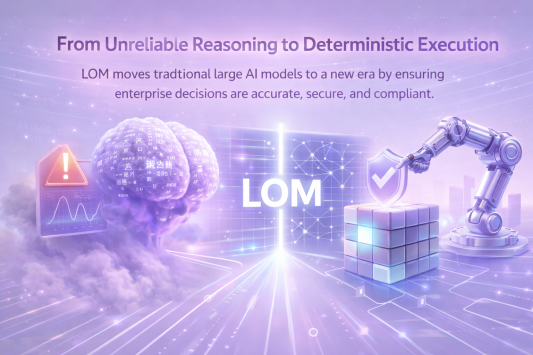
In practical commercial applications, relying on three core capabilities of deep business cognition, closed-loop logical output, and professional-generalization synergy, LOM has realized an upgrade from an “AI assistant tool” to an “autonomous decision system”. In terms of deep business cognition, LOM goes beyond the general understanding of concepts such as “orders” and “customers”, and can accurately grasp the enterprise-specific business rules, process states and system correlations, ensuring that decisions are highly consistent with the actual enterprise business; in terms of closed-loop logical output, LOM conducts real-time verification of output results through the ontology’s business rule system, greatly reducing hallucinations and logical contradictions, and its output can directly drive system interfaces and execute business processes, forming a complete closed loop of “analysis-decision-execution”; in terms of professional-generalization synergy, LOM maintains high accuracy in enterprise-grade professional tasks while retaining the general conversational capabilities of mainstream large models, becoming an efficient collaborative partner for all enterprise personnel.
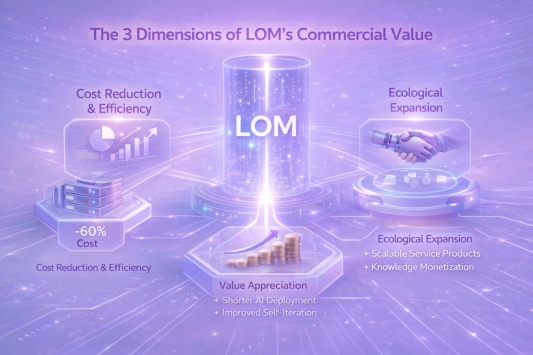
The commercial value of LOM is also reflected in three dimensions: cost reduction and efficiency improvement, value appreciation, and ecological expansion: it provides pre-configured industry ontologies for manufacturing, finance, retail and other industries, shortening the AI deployment cycle from months to weeks and reducing the total cost of ownership by 60%; by continuously absorbing enterprise operation data, LOM can continuously optimize business processes, form a virtuous cycle of self-iteration, and achieve sustained improvement in operational efficiency; more importantly, LOM enables enterprises to transform proprietary knowledge into scalable service products, such as predictive maintenance subscriptions for manufacturing enterprises and demand analysis services for retail enterprises, helping enterprises develop high-margin recurring service models and realize the commercial monetization of knowledge assets.
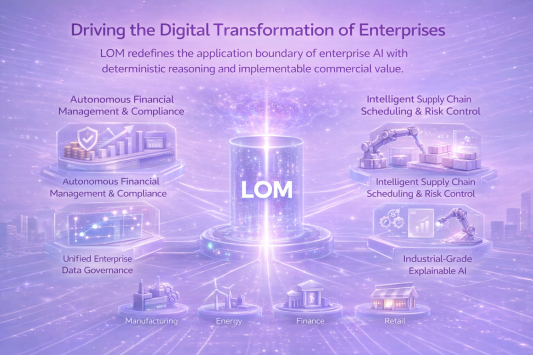
At present, LOM can support core scenarios such as autonomous financial management and compliance, intelligent supply chain scheduling and risk control, unified enterprise data governance, and industrial-grade explainable AI. It can also be integrated with action-oriented AI models such as xLAM to form a closed-loop enterprise AI system of “knowledge reasoning-task execution”. From manufacturing and energy to finance and retail, LOM is becoming the core driving force of enterprise digital transformation with its deterministic reasoning capability and implementable commercial value, redefining the application boundary of enterprise AI.