Yonyou Enterprise Digitalization
Digital Transformation Has Become The Main Theme of Digital Economy Development
At present, the industry generally believes that we are entering an era of uncertainty, the law of industrial development is obviously weakening, and the problems of complexity, randomness, and unpredictability are increasing. These uncertain issues have brought many challenges to business operations, and this is also the fundamental reason for companies to accelerate their digital transformation.
In the digital age, business operations are faced with many uncertain factors:
-
- There are macro-environmental factors from policy adjustments, market competition, changes, technological evolution, etc.
- There are also micro-environmental factors from multiple value chain links such as R&D and design, manufacturing, product services, and industrial chain collaboration.
- There are also stakeholder factors from multiple subjects such as employees, partners, competitors, and users.
These uncertain factors are intertwined, so that business managers are facing unprecedented challenges such as diversification of market demand, value-added products and services, complex production processes, and multidimensional industrial collaboration.
However, how should enterprise managers respond effectively? Faced with unavoidable or even unpredictable challenges, adapting to changes and taking advantage of the trend is our only choice. Digital transformation has become a consensus to resolve and deal with the uncertainties caused by environmental changes.
The Digital Transformation of Enterprises Has Entered the "Deep End of Its Reform"
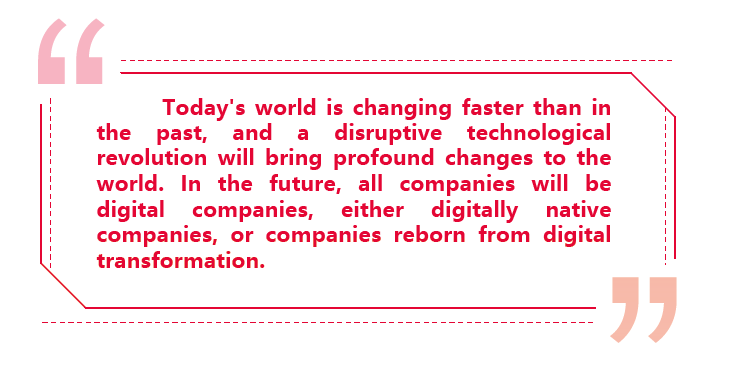
For enterprises, digital transformation is no longer a multiple-choice question, but a survival question. Nowadays, digital transformation has become an inevitable trend for enterprises, and more enterprises are embarking on the “exploratory journey” of digital transformation. In this process, new terms such as enterprise cloud, smart manufacturing, and digital enterprise have emerged, and new technologies such as cloud computing, big data, 5G, and blockchain have also emerged. These will make many business managers confused in the face of transformation. In the past two years, many companies have gone through digital exploration, and have accumulated lessons after trial and error or experience with initial results.
The digital transformation of enterprises is facing a larger scale and a deeper level of digital transformation challenges, and digital actions need to be changed from random to orderly. At this stage, labor factors have changed, cloud computing has become a new type of labor, artificial intelligence has become a new type of production tool, and big data has become a new type of production material; Non-data-intensive industries in the traditional sense such as manufacturing and service industries have begun to generate massive amounts of data, and data has become one of the basic production factors of various industries; ICT is deeply integrated with the industry, transforming from the support system of the enterprise to the production system; The goal of enterprise digitization is no longer satisfied with the efficiency improvement of the original business, but has begun to focus on the value creation of the new business.
The Definition of Enterprise Digitization
Today, our industry has many new concepts about enterprise digital transformation. However, in terms of its essence, we find that each concept represents a different perspective on enterprise digitalization. How to understand enterprise digitization more comprehensively, we need to understand the overall situation of enterprise digitization from a macro perspective, pay attention to the details of enterprise digitization from a micro perspective, and look at the essence through phenomena to clarify the essence of enterprise digitization.
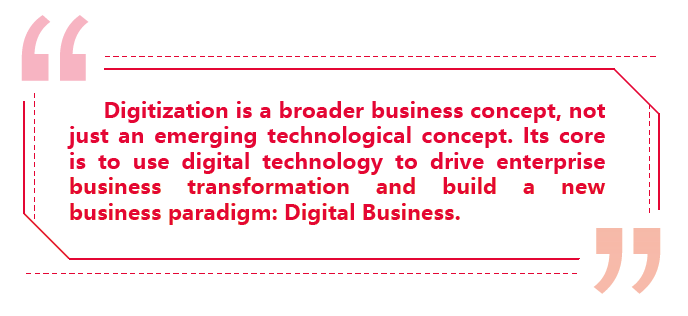
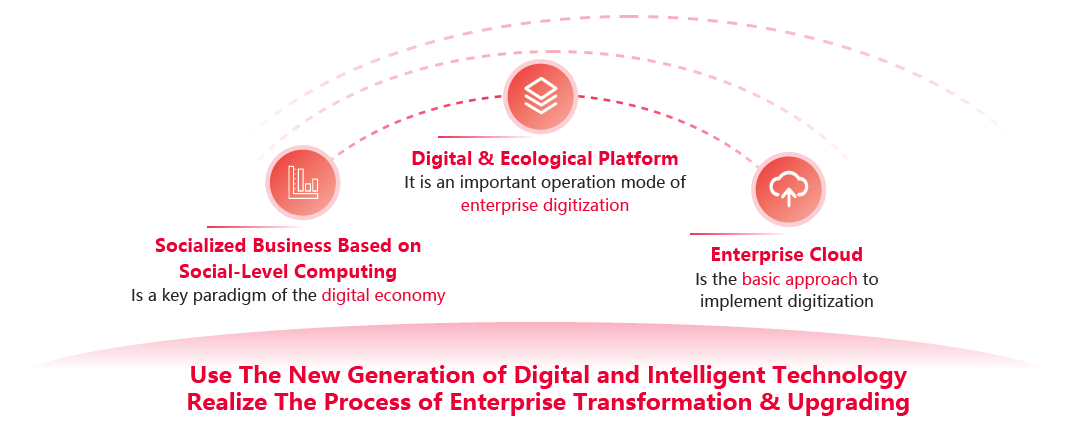
From a macro perspective, we believe that enterprise digitization is based on the in-depth application of a new generation of digital and intelligent technologies with the help of social-grade computing platforms. The in-depth integration of the digital economy and the real economy is characterized by connection, collaboration, and sharing, and new business models and models such as the sharing economy, industrial Internet, and API economy as representative of a new business paradigm-Digital Business.
From a micro perspective, we believe that enterprise digitization is to run various cloud services based on a new generation of digital and intelligent technologies, through network collaboration, data intelligence, connecting resources, reorganizing processes, empowering organizations, processing transactions, performing operations, integrate into the digital economy and promote business innovation (R&D, production, marketing, service, etc.), management reform, financial embedding, thereby transforming production, operation, and management methods, and realizing the progress process of stronger competitive advantage, higher operating performance, and more sustainable development.
However, in its essence, we believe that enterprise digitization is a process of using a new generation of digital and intelligent technologies to optimize the efficiency of resource allocation in a world defined by data + algorithms, build new competitive advantages for enterprises, and realize enterprise transformation and upgrading.
Decode the Digital Business Paradigm
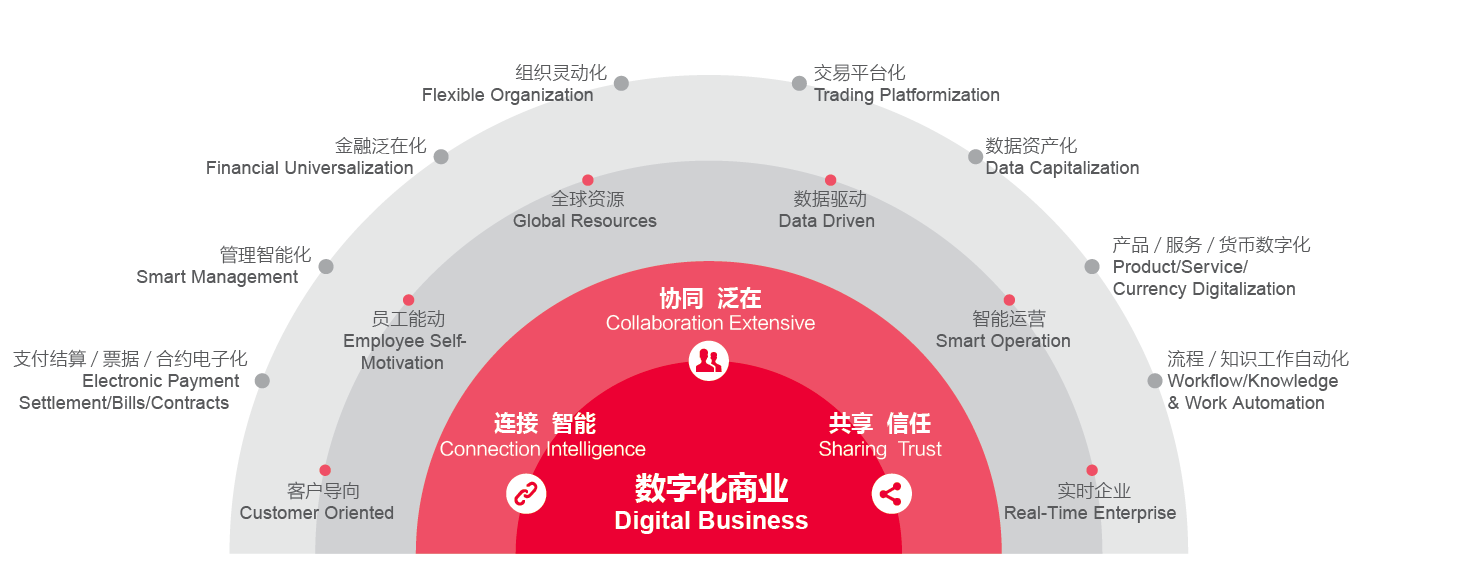
Traditional enterprises must rethink and face future business changes in the face of the huge challenges and opportunities brought by digital technology. Today’s business is very different from the past, and a brand-new business paradigm-digital business is on the rise. Different from the traditional business paradigm, the digital business paradigm has obvious Internet attributes such as digitization, networking, and intelligence. All business activities reflect the basic characteristics of connection, sharing, and collaboration. At the same time, the company’s business model, business strategy, user experience, marketing channels, organizational model, product development, customer service, and operations have undergone earth-shaking changes.
Customer Oriented
Production and operation have shifted from manufacturer-oriented to customer-oriented, establishing a customer-centric business model and business process
Employee Self-Motivation
The enterprise organization has shifted from the traditional top-down model to the employee initiative model, becoming an empowering platform for employees
Data-Driven
Business operations and management have shifted from process-driven to data-driven, and data transcending processes has become the new core of operations
Smart Operation
Enterprise operation has shifted from business process informatization to full automation and intelligence, and intelligent management has become the basic requirement of enterprise operation
Global Resources
Enterprise resources shift from local resource operation to global resource integration. Buying, selling, and cooperating globally will become the key competitiveness of future enterprises
Real-time Enterprise
The state of enterprise operation has shifted from delayed operation to real-time operation, and the dream of “real-time enterprise” has been truly realized
Yonyou's Digital Transformation Method
The vast majority of companies have realized the importance of digitalization and have begun to formulate digital strategies and action plans. However, the digital transformation of many companies has many problems: incomplete understanding, unclear strategies, inadequate execution, and insignificant results, and many pioneers have stopped reforming after several failed explorations. We hope that this set of corporate digital transformation methodology will become a program of action for corporate digital transformation, helping companies combine their own industry characteristics to embark on a path of dynamic evolution and continuous iterative innovation and change, and then achieve digital evolution.
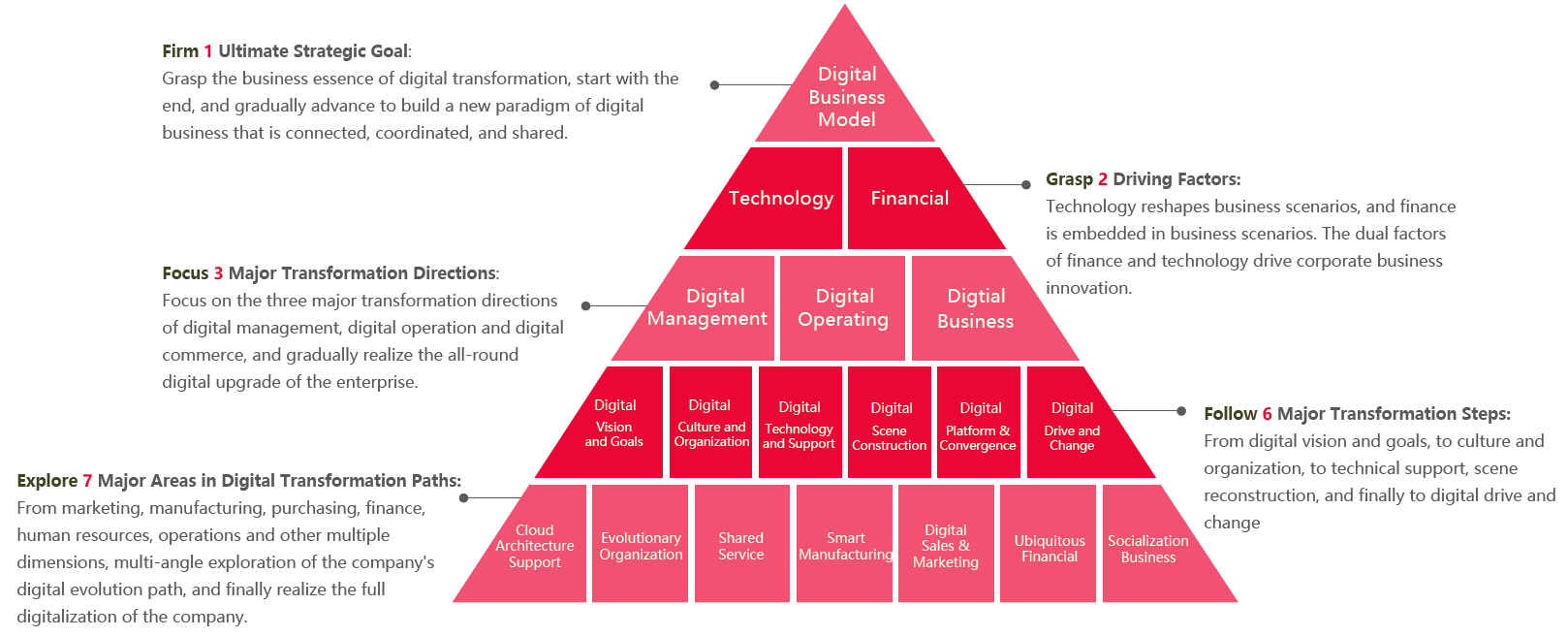
We hope that this set of corporate digital transformation methodology will become a program of action for corporate digital transformation, helping companies combine their own industry characteristics to embark on a path of dynamic evolution and continuous iterative innovation and change, and then achieve digital evolution.
Consult us more today!