Enterprise Resource Planning
What is Enterprise Resource Planning (ERP)?
ERP can be defined as concepts and systems. Conceptually, the ERP system “involves the integration of internal business processes within the organization, including improved order management and control, accurate inventory information, improved workflow and supply chain, and better business and best practice standardization”. In this sense, the ERP concept emphasizes the institutional changes that occur when the phenomenon is introduced and maintained.
ERP systems are often regarded as “technical infrastructure designed to provide the functions needed to turn ERP concepts into reality”. In this sense, the ERP system is the core software program used by the company to integrate and coordinate information in various fields of business, including finance, supply chain, manufacturing, operation, service, procurement and etc. It uses public databases and shared management reporting tools to help organizations manage company-wide business processes.
History and Evolution of ERP
In the 1940s:
In order to solve the inventory control problem, people proposed the order point method, when computer systems had not yet appeared.
In the 1960s:
With the development of computer systems, it became possible to perform complex calculations on a large amount of data in a short period of time. In order to solve the shortcomings of the order point method, people put forward the MRP theory, as a kind of inventory order planning—MRP (Material Requirements Planning), that is, the material requirements planning stage or the basic MRP stage.
In the 1970s:
With the deepening of people’s understanding and the further popularization of computer systems, the theoretical category of MRP has also been developed. In order to solve the management of procurement, inventory, production and sales, the production capacity demand plan, workshop operation plan month, and purchase operation plan theory has been developed as a production planning and control system—Closed-loop MRP.
In the 1980s:
With the development of computer network technology, the internal information of the enterprise has been fully shared, and the various subsystems of MRP have also been unified, forming a subsystem integrating procurement, inventory, production, sales, finance, and engineering technology. Developed the MRP Ⅱ theory, as a kind of enterprise management information system—Manufacturing Resources Planning Ⅱ. The representative technology at this stage is CIMS (Computer Integrated Manufacturing System).
In the 1990s:
With the further intensification of market competition, the competition space and scope of enterprises have further expanded. MRPⅡ was mainly oriented to the idea of comprehensive planning and management of internal resources of enterprises gradually developed into the management thought of how to effectively use and manage the overall resources in the 1990s, and ERP (Enterprise Resources Planning) came into being.
ERP was first proposed by Gartner Group Inc. in the early 1990s. The explanation at that time was based on the development of computer technology, supply and demand chain management, inferring the development trends and changes of management information systems in various manufacturing industries in the information age.
ERP Stage:
After entering the ERP stage, the computer-centric enterprise-level management system has become more mature, and the system has added functions including financial forecasting, production capacity, and resource adjustment adjustments. Cooperate with enterprises to realize the functions of comprehensive JIT management, quality management, production resource scheduling management, and decision-making assistance. Become a platform tool for enterprises to carry out production management and decision-making.
ERP in The E-commerce Era
The maturity of Internet technology has increased the ability of enterprise information management systems to realize information sharing and direct data exchange with customers or suppliers, thereby strengthening the links between enterprises and forming a survival chain of common development and reflects the supply chain management ideas of enterprises to achieve survival and competition.
The ERP system realizes this function accordingly, enabling decision-makers and business departments to realize cross-enterprise joint operations. It can be seen that the application of ERP can indeed effectively promote the modernization and scientificization of existing enterprise management and adapt to the increasingly competitive market requirements. Its introduction has become the general trend.
The Modern ERP
The ERP of the current era firmly grasps the mainline of the enterprise information process and provides highly professional ERP for the industry for the purpose of production and operation.
3 Signs Showing You Need ERP
If you are reading this article and are struggling with the old system, you may already know that implementing ERP is imperative, but here are some signs that you need a new ERP system now:
1
Current Functions Cannot Help You Grow
Perhaps the basic functions have helped you achieve good development, but if your current software limits your ability to expand in the market and grow on a global scale, then it may be time to deploy a system that helps you break through the limitations.
2
Using Many Different Systems At Once
As technology advances, you will find that your many different systems cannot work well together. You may have realized that the new accounting software is not compatible with the old HR system, and you are tired of wasting time and resources trying to put together a solution.
3
Not Capable To Meet Client Expectations
If mobility was a common routine to your employees and client, but your system cannot adapt to them, then it’s time to invest in a system that meets everyone’s needs. Provide them with the tools they need to succeed instead of push them to a competitive business
Why Should Companies Introduce ERP
With the rapid development of society nowadays, both the economy and technology are undergoing rapid changes. In order for enterprises to adapt to this fast-paced development, management transformation is a must. When an enterprise develops to a certain stage, conventional management obviously can no longer meet the needs of actual development, so how to achieve standardized management to improve business efficiency has become a new topic.
Although there is no universal solution software for all business processes, ERP technology is advancing day by day and integrating all business processes together to improve collaboration, help your enterprise make data-driven decisions, and increase corporate productivity. ERP can serve many functions, but some of the main business processes include:
Finance:
Modern ERP can provide dashboards showing financial overview, so you can get real-time information anytime, anywhere. It also helps you reduce manual input of the information by automating daily tasks, and includes tracking features to help your business comply.
Human Resources
Modern solutions can provide ways to manage company data and simplify employee management tasks such as payroll, recruitment, and other responsibilities. You can also track employee performance and identify HR issues in advance.
Manufacturing:
This feature can improve business communication, automate daily processes, and enable manufacturers to access real-time data to meet customer needs and manage resources. This solution can also optimize project and cost management and production planning.
Supply Chain:
If your company is still manually entering information and trying to track inventory in your warehouse, you can easily save time and money by automating these processes using ERP. Modern solutions can also provide dashboards and business intelligence to help you master inventory management.
Why ERP Is Important To Your Business
1. ERP provides an integrated information system for enterprises, enabling them to share business data and resources.
2. Standardize the business process of the enterprise, realize the standardization of business processing, and provide data integration. The arbitrariness of business processing is prohibited by the system, which strengthens the basic work of enterprise management and further guarantees the quality of work.
3. Data processing is done automatically by the system, so the accuracy is greatly improved, which not only reduces the lightness of work but also frees corporate managers from tedious tasks, allowing them to have more time To study the problems in the business process. Research and use modern management methods to improve management and promote the wide application of modern management methods in enterprises.
4. Strengthen internal control, achieve clear division of labor and timely control in work control, problems in each link can be reflected at any time, and the system can provide the data required for performance evaluation, so as to achieve “corporate management”.
5. Automatically coordinate the business of various departments through the application of the system, so that the resources of the enterprise are unified, the inventory is reduced, the speed of capital turnover is accelerated, and the various departments are united into an overall coordinated operation with a team spirit.
6. To help decision-making, the company’s decision-making level can obtain the dynamic business data of the enterprise contract and the analysis function of the ERP system to assist the enterprise in making the correct decision.
7. ERP contains advanced management ideas, forms, processes, and helps companies establish a management system that includes pre-planning, in-event control, and post-event analysis, and strengthens corporate flexibility and innovation. Complementary advantages of low-cost operation make the quick ones faster and the strong ones stronger.
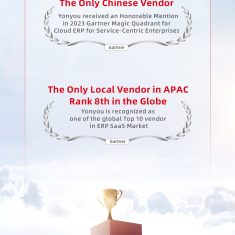
Now that you have a good grasp of ERP, understand how Yonyou ERP Solutions delivers the benefits of enterprise resource planning for your business-such as optimizing finance and operations to help you and your team make data-driven decisions to improve business performance.